Tenants in Singapore operate within a layered set of rules: the general law of contract (what the tenancy agreement says), HDB's specific renovation guidelines for public housing, and URA requirements for private residential property. These three frameworks don't always align cleanly, and the gap creates genuine confusion about what a tenant can do without seeking permission — and what happens if they don't.
The practical answer for most security device installations is: items that leave no permanent trace on the structure are generally permissible without landlord consent. Items that alter the building fabric — holes, adhesive damage, structural changes to doors and windows — sit in a grey zone that depends on the specific tenancy agreement and, for HDB flats, HDB's published renovation requirements.
This article is a general information reference. It does not constitute legal advice. Specific questions about a tenancy agreement or HDB renovation rules should be directed to a qualified property lawyer or the HDB Branch Office serving your estate.
HDB Renovation Rules for Tenants
HDB's renovation guidelines apply to the lessee (owner) of the flat, but by extension shape what landlords can permit their tenants to do. The key distinction HDB draws is between works that require a permit (structural works, hacking, electrical rewiring, wet works) and works that are exempt from permit requirements but still subject to conditions (painting, carpentry that doesn't affect walls, adding non-structural fixtures).
Security device installation falls almost entirely into the exempt category, provided:
- No hacking of walls or ceilings takes place
- No rewiring of fixed electrical circuits is performed
- All fixtures can be removed and surfaces restored on vacating
Typically Permissible Without Written Consent
Adhesive-Mounted Cameras
Indoor cameras mounted using removable adhesive strips (3M Command strips rated for the camera's weight) leave no lasting damage to walls or ceilings. These are functionally equivalent to hanging a picture frame and are not considered a renovation under HDB guidelines. Cameras mounted on door frames using magnetic bases similarly leave no trace. Both are generally permissible without landlord consent under standard Singapore tenancy agreements.
Plug-In Motion Sensors and Alarm Units
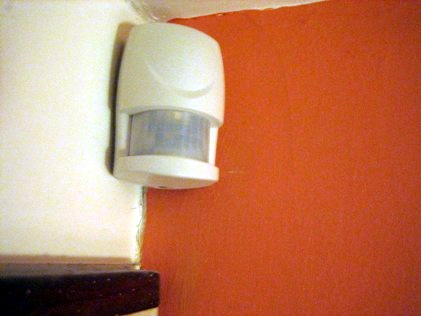
Standalone motion sensors, door/window contact alarms, and glass-break detectors that plug into power sockets or run on batteries require no installation at all in the technical sense. These are portable appliances. A tenant adding a Philips Hue Motion Sensor or a contact alarm to a bedroom window is no different from adding a lamp.

Retrofit Smart Locks
A retrofit smart lock that fits over the existing thumb-turn without replacing the cylinder is not a structural modification to the door. The original lock mechanism is preserved intact. When the tenancy ends, the retrofit unit is removed and the door returns to its original state. This type of installation is broadly considered non-structural and does not require HDB renovation permit or landlord consent under most standard tenancy agreements.
However, the tenancy agreement itself may contain clauses requiring written landlord consent for any change to door hardware. Check section clauses relating to "alterations" and "security devices" specifically before proceeding.
Video Doorbells (Battery-Powered)
Battery-powered video doorbells that attach to an existing doorbell mounting point, door frame, or adhesive mount do not require any electrical work. The Ring Video Doorbell (3rd gen and later) and Eufy Video Doorbell 2K both offer battery-powered variants with this characteristic. Wired video doorbells that require connecting to existing doorbell wiring are a different matter — this involves working with fixed electrical circuits and is subject to HDB permit requirements if done in an HDB flat.
What Typically Requires Written Landlord Consent
Replacing the Door Lock Cylinder
Replacing the physical lock cylinder — which is what a full digital deadbolt installation involves — changes the door hardware in a way that gives the tenant control over who can access the property with a physical key. Most tenancy agreements address this explicitly: landlords are generally entitled to retain a set of keys for emergency access, and replacing the cylinder without consent may constitute a breach of the tenancy agreement.
The practical resolution is straightforward: inform the landlord in writing, explain the type of lock being installed, confirm that a key override is available, and offer to provide the landlord with a copy of the physical backup key or emergency access code. Most landlords in Singapore's rental market accept digital lock installation when approached this way.
Drilling into Common Area Walls
Corridor walls in HDB estates are common property managed by the Town Council. No tenant or flat owner has the right to drill into them without Town Council approval. This means cameras intended to monitor the corridor approach must use alternative mounting solutions — door-frame clips, adhesive anchor systems, or camera positions set back inside the unit's doorway.
External Alarm Boxes
Wall-mounted external alarm boxes (the visible deterrent boxes typical of older security systems) require drilling into the exterior façade. In HDB flats, the exterior façade is HDB common property. In private condominiums, it falls under MCST jurisdiction. Neither permits drilling without formal approval. Modern wireless alarm systems avoid this by using internal siren units that require no external mounting.
Before You Install: Documentation Checklist
Regardless of whether a device requires consent, documenting the pre-installation state of the flat protects tenants when it's time to vacate. Before installing any security device:
- Photograph or video the exact area where the device will be mounted
- Note the wall/surface material (painted plaster, tile, timber, metal) and its current condition
- Keep receipts for all devices and mounting hardware
- If the landlord grants verbal consent, follow up with an email to create a written record
- On vacating, restore surfaces to original condition and photograph the finished state
Security Deposits and Damage Claims
Singapore tenancy agreements typically specify a security deposit of one to two months' rent. Deductions from this deposit for "damage" caused by a tenant are a common source of disputes. For security device installations, the risk of deposit deduction arises when:
- Adhesive mounts remove paint when stripped — use removal-safe strips and test on an inconspicuous area first
- Smart lock installation leaves marks on the door surface — use felt pads under mounting plates
- Camera cable routing leaves adhesive residue — use cable clips rated for clean removal
The Council for Estate Agencies (CEA) publishes guidance on deposit disputes, and tenants with contested claims can seek mediation through the Singapore Mediation Centre.
Related Reading
For practical guidance on selecting security cameras that work without drilling, see Choosing an IP Camera for Your Rented Flat. For a comparison of smart lock types and their installation requirements, see Smart Locks in Singapore: Comparison of Retrofit and Deadbolt Models.